
Toffy's Story
14 min read
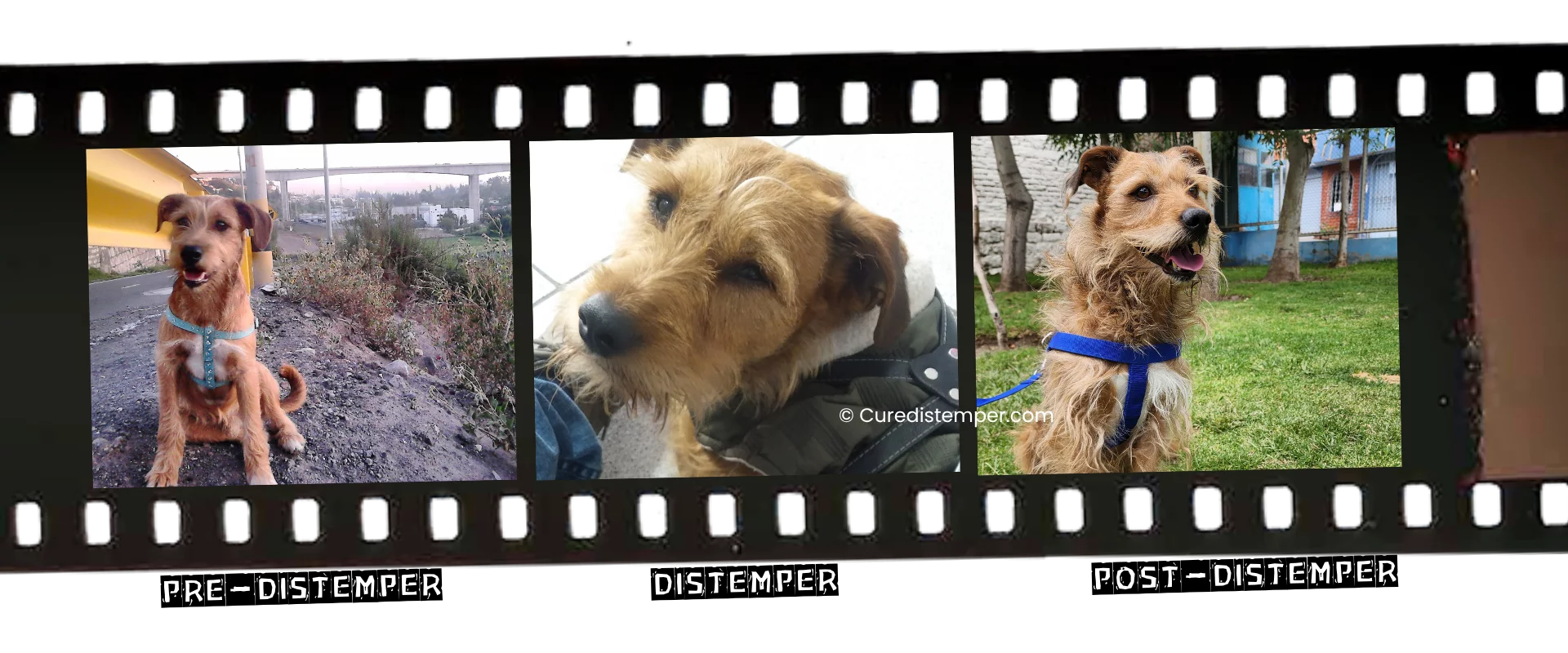
Toffy: "The dog who lived"
The fight against distemper
As told by his caregiver: Adrian Bayron OM.
Toffy, whom you can see in the photos above, was born on September 8, 2016, in a city in southern Peru. He came from a litter of 5 puppies, out of a Schnauzer mother and an unknown father, and I adopted him when he was just a few months old. He arrived with his unmistakable birthmark — a white heart drawn on his chest by his own fur. Toffy is the one on the right:

When he was already 10 months old, one Sunday afternoon in June 2017, we went out for a walk a few kilometers from home, to a country landscape we used to visit often — but something was off. His mood wasn't the usual one, and it was on that outing that I started to notice the first symptoms of what turned out to be distemper, a terrible disease I knew absolutely nothing about at the time. In the image below you can see his expression — dull, even though we were usually having a great time on our walks. This time he wasn't his lively self; he was walking and running, but he looked weak. He was already suffering, and the symptoms would become more obvious and worrying afterward. It was Sunday afternoon — no vet clinic would be open.

The next day, Monday, before heading to work, I went early to the closest vet clinic to my house, just a block away. It was a small, plain-looking place with a single staff member (the vet) and a few pet food items for sale. His advice was not to medicate anything and just wait for the puppy to heal on his own, because, according to him, medicating humans and dogs for everything is a bad habit of today's society. I didn't argue, but I wasn't satisfied with the service.
I went to another vet clinic a few blocks from home. I was seen by a very kind and empathetic veterinarian, who took Toffy's measurements — body temperature, stethoscope auscultation, and symptom evaluation. Her conclusion was that what was affecting Toffy was a canine flu or influenza, and she prescribed a cough expectorant and a nutritional supplement. We bought the prescription, went back home, and I went to work; my mother stayed home and would let me know if any emergency came up. Either way, what the doctor had told me had already given me some peace of mind — I breathed a sigh of relief thinking my dog would soon be free of that flu. But obviously, things did not get better.
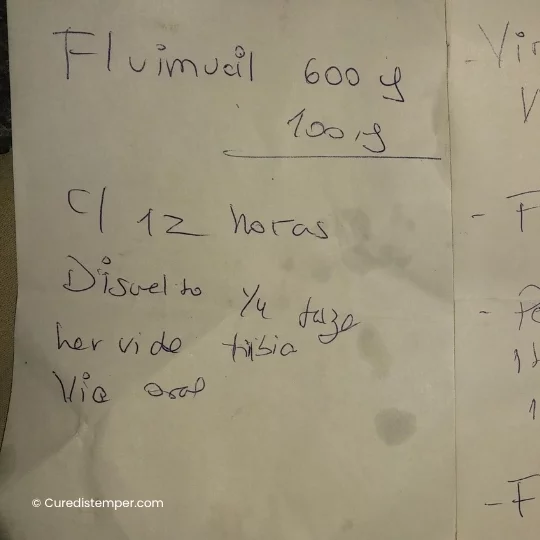
It turned out that almost a week later, the symptoms had done nothing but get worse. Toffy had a cough, thick mucus discharge from his little nose, dryness on his nose and paws, listlessness, and — the worst part at that moment — his eyes started to close, full of crust, all curled shut. We went back to the vet clinic, another evaluation, no lab tests — it seemed that clinic didn't have the equipment, and I had no idea what should or shouldn't be done. So she recommended I keep giving him the same flu medication, but for the eye issue she recommended visiting a canine ophthalmology specialist. She gave me the specialist's contact information and I booked the appointment.
The flu medication the doctor had prescribed helped with just one symptom but did nothing to address the underlying problem, which by then still hadn't been diagnosed — we still believed it was just a canine flu. That leads me to a reflection: even when a veterinarian is very kind and shows real love for animals, that shouldn't automatically make us trust their competence for the job at hand. Veterinarians have to know how to treat almost every kind of small animal (horses, dogs, cats, parrots, rodents, etc.), and they may lack certain specific knowledge simply because the field branches out so much. All we can do is trust the experts in each specialty — and even with them, we have an obligation to inform ourselves about certain basics of what we're dealing with. For example, imagine taking your car to the mechanic and being told there's a problem with the gearbox and that you need to buy 4 new transmissions to fix it. Yes, that's absurd if you know even a little about what's under your car's hood, since a normal car only has one transmission — but if you know nothing about the subject, you could believe it blindly and get scammed.
According to a 2024 study by the Centers for Disease Control and Prevention and the British Medical Journal, misdiagnosis is the third leading cause of death in humans in the US. If that's the statistic for humans, imagine what it's like in veterinary medicine, which isn't under the same strict scrutiny as human medicine, and whose statistics are therefore unknown.
When it comes to diseases with a serious prognosis, I always recommend researching the basic information yourself. At distemperscience.com you'll have access to in-depth knowledge, as well as basic but crucial knowledge, so you understand what the disease involves and how to fight it more effectively, so your puppy can win the battle and survive.
Back to Toffy — we went to the dog ophthalmologist one morning; below you can see the photo from that day, his condition was pitiful, worry ruled my thoughts. There was a patient being seen before us, and then it would be our turn — I overheard that the patient, a boxer, didn't have much time left and that the cancer was too advanced. It was heartbreaking to hear that, because anyone who loves dogs feels the pain when there's suffering in other dogs.
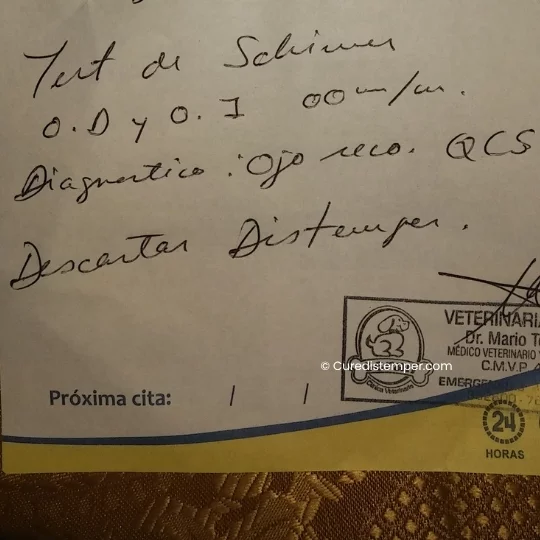
Our turn came, we went in with the ophthalmologist, and the evaluation was quite thorough — eye instruments, questions and answers. The vet's conclusion was dry keratoconjunctivitis, and then came the big moment of truth: he told me to rule out distemper, since the group of symptoms my little guy was showing matched that disease. He prescribed eye medication, we bought it, and went back to the first doctor, more worried than before.
The doctor ran the rapid distemper test on him, which works like a pregnancy test. Normally you have to wait 5 to 10 minutes to get the result. In my case, we waited only a few minutes and looked at the test. I felt peace and relief when we saw it came back negative — the two lines that would mean a positive distemper result hadn't shown up. Back home, and keep up with the medication — things had to start getting better. Right?
Needless to say, nothing got better. I kept the test, and decided to consult another vet near my house. I told this new vet about the symptoms and gave him the test so he could see with his own eyes that we had already ruled out distemper. And this is where the big moment of truth arrived: the test showed two lines.
It turned out that with the other doctor we hadn't waited the proper amount of time for the test to fully develop, and we had declared victory too soon. Now we had a diagnosis — a painful one, but at least we finally knew what all of this was, and many days had already gone by since it all started. Now we started a new medication routine set by the new vet, who warned me that the disease has a high probability of killing the dog since there was no fixed or established cure, so all that was left was to treat the symptoms and see how the dog's immune system would respond.
Days after learning the diagnosis, the symptoms got worse — on top of everything I already mentioned, diarrhea and loss of appetite were added. I was flooded with depression and frequent crying; I loved, and still love, this little dog so much, and I didn't want him to suffer and die from this disease. Below is a photo from those days:

Today, at 34 years old as I write these lines (it's March 2026), I've learned that death is part of life. Dying is the destiny we all share in this world. Nothing belongs to us, and we shouldn't judge anyone's death as an injustice or as cruelty from life or from some God or higher power — things just happen, that's all. But that doesn't mean we're going to give up without a fight — staying alive, happy, and healthy, us and our dogs, is part of enjoying our time in this world while we're here.
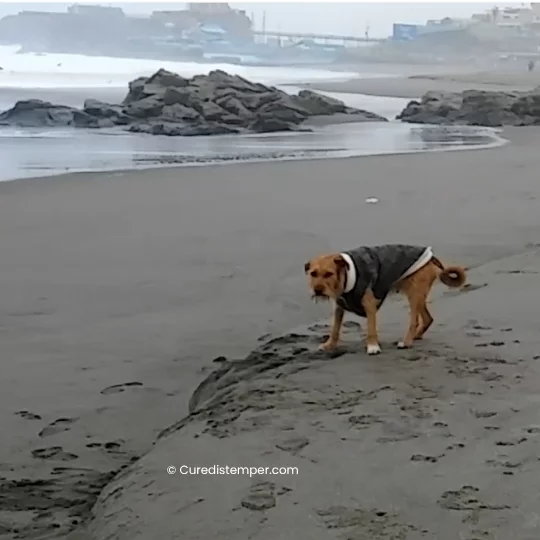
A family member suggested I let Toffy see the ocean, in case he didn't make it — at least he'd get to see something majestic before leaving. I thought it was a lovely idea. I didn't have my own car at the time, so we went to the nearest beach, 3 hours away from my city. It wasn't summer season, and it wasn't unbearably cold either, so once we arrived we started our walk — him listless but curious. We stayed there for quite a while. When a wave reached his paws and got them wet, I got scared because I didn't want to make things worse. Fortunately it was just a little water. That night Toffy started shaking a lot and kept looking for the cold floor to lie down on — he didn't want warmth, he had a high fever, and this repeated for several more nights.
I think taking a convalescing animal to the beach can be a bad idea, and you should only do it with your vet's approval — but if you do, the ocean's energy might work as a bit of relief and lift both your dog's spirits and yours. Just make sure neither the trip nor the destination stresses your dog out, since that's harmful — plan around the weather, the number of people around, the distance, etc. At this point what he needs most is comfort and a favorable environment. Here's an image of him walking along the shore:
The next day we went back to our city, and a new symptom was waiting for us — the most feared part of distemper, the neurological phase. Even with the weight of the world on me, I never gave up, which is why I wanted to widen the range of options and opinions, so I took my baby to another vet clinic farther away, where they told me the same thing as the previous doctor. It wasn't wasted effort, since I had now confirmed the information with more than one source. In total we had gone to 5 different vets. A great decision, and one I always recommend — in human and veterinary health, and in general — triangulating the opinions of at least three experts, advice that Ray Dalio himself shares in his book "Principles." Good book, and recommended, by the way. We went back to the previous vet, since he was closer.
I started researching papers, studies, investigations, websites, blogs, videos, forums, and every resource published on the internet about distemper. Eight years later, it's still a disease under active research, with no fixed cure that's 100% effective — but thanks to hard work and partnering with my vet, we put together a treatment that we applied to my dog back then, and which we've since updated to modern times to make it useful and highly effective. You can purchase access to all the resources here at distemperscience.com.
I coordinated Toffy's entire treatment — we went to the vet clinic several days a week for treatment and progress evaluation.
The most serious issue was the loss of appetite — this is extremely crucial, because as the saying goes, "a sick one who eats doesn't die." The last thing I wanted was for my baby to keep suffering, so it was the symptom we focused on most urgently. At this point I want to make clear that even though it was obvious my dog was doing very poorly, he still showed me his will to keep fighting. I'm in favor of euthanasia when a dog's situation is untenable and the most loving and compassionate thing is to let the dog rest. In fact, there are already studied methods you can use to more precisely determine whether, in your case, it's time to let your dog go — you also have access to that inside the site.
As the treatment took effect, days went by, his little eyes started to get better, then the diarrhea became less frequent, the neurological symptoms disappeared, and all that was left was the dryness on his paws and nose, which took much longer to heal, but it's a minor issue and it keeps improving with treatment. Here's a recent double photo of him, with his unmistakable white heart on his chest:

Over the course of that 8-week journey we suffered — Toffy more than me — it was an ordeal of symptoms that my baby's little body and mind had to endure. I prayed for time to pass quickly, because the key here is for the dog to be able to hold on through the time the disease lasts, which is usually a maximum of eight weeks. In the end, success came — Toffy survived. As I write this story, he's alive and kicking, he's lived through many experiences, and he's a whole distinguished old man now. If your dog is going through distemper, do everything you can to save him — even if you don't buy this content, do your research, take him to different vets, don't be a pessimist. Your dog is counting on you — he can't do research on his own or pay for the vet himself. The only thing he can do against distemper is put his immune system to work, with everything it's got. It's your duty as his caregiver to equip him with proper treatment and strengthen his tools so he comes out of this alive. Act now — time is the most critical thing.

Powerful information to save your puppy
BEAT DISTEMPER
If you want access to more detailed information about advanced treatment options, support protocols, and updates based on recent research, I invite you to purchase access to the distemperscience.com website. This subscription will give you exclusive resources and support to navigate this situation with greater confidence.